The Triple Crisis: Why Renewable Energy and Biodiversity Must Be Addressed Together
In recent years, plans for solar development near Kushiro Shitsugen, a UNESCO Ramsar-listed wetland in Hokkaido, sparked national controversy. For developers, the projects represented progress toward Japan’s renewable energy targets. For residents and conservation groups, they represented an existential threat to the endangered red-crowned cranes and other species that depend on these wetlands for survival. The resulting conflict — public opposition, media scrutiny, and policy backlash — exposed a fundamental tension in Japan’s energy transition: how can the country expand renewable energy while protecting the very ecosystems that climate action aims to save?
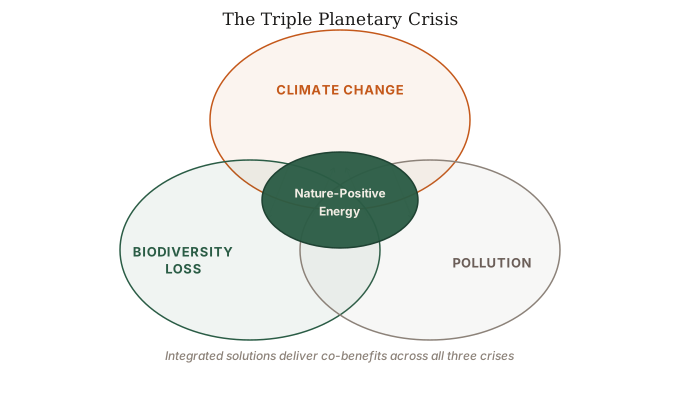
This is not simply a local conflict. It is a manifestation of what the United Nations Environment Programme calls the “triple planetary crisis” — the interconnected threats of climate change, biodiversity loss, and pollution. And Japan’s accelerated push toward its 2030 renewable energy targets has made this crisis impossible to ignore.
Three Crises, One System
The numbers tell a stark story. Since 1970, global wildlife populations have declined by 73 percent, according to the World Wide Fund for Nature’s 2024 Living Planet Report. Over the same period, atmospheric carbon dioxide concentrations have risen from 325 parts per million to over 420 ppm, driving unprecedented climate disruption. Meanwhile, fossil fuel combustion and industrial activities contribute to pollution that exacerbates both climate change and biodiversity loss — a feedback loop that threatens to accelerate collapse across multiple Earth systems.
What makes this crisis “triple” is not just the simultaneity of these three threats, but their deep mechanistic interconnections. Climate change alters species distributions, disrupts ecological timing, and pushes ecosystems beyond their adaptive capacity. Biodiversity loss, in turn, undermines nature’s ability to sequester carbon and buffer climate impacts — natural ecosystems absorb more than 50 percent of anthropogenic CO₂ emissions through photosynthesis and ocean dissolution. And pollution, from plastic waste in oceans to nitrogen runoff in agricultural systems, compounds stress on both climate and biodiversity.
The 2021 IPBES-IPCC co-sponsored workshop report on biodiversity and climate change made this explicit: “The mutual reinforcing of climate change and biodiversity loss means that satisfactorily resolving either issue requires consideration of the other.” Previous policies, the report noted, have largely tackled these problems independently — climate through emissions reduction targets, biodiversity through protected area designations. This siloed approach, effective as it may have been in earlier decades, is no longer sufficient in an era of compounding crises.
The Renewable Energy Paradox
Here is where Japan’s dilemma becomes acute. To meet the Paris Agreement’s 1.5°C warming limit and honor its commitments under the 28th Conference of the Parties (COP28) UAE Consensus, global renewable electricity capacity must triple by 2030. Japan’s response has been comparatively cautious: the 7th Strategic Energy Plan, approved in early 2025, targets renewable energy to account for 40–50% of electricity generation by fiscal year 2040 — a timeline considerably slower than many industrialized nations. Even these modest targets require substantial expansion of solar photovoltaics and onshore wind, the two renewable technologies with the fastest deployment potential and declining costs.
Yet these very technologies, when poorly sited or carelessly implemented, can become agents of biodiversity loss. Large-scale solar farms require land clearing that destroys habitat. Wind turbines, particularly in migratory flyways or near sensitive ecosystems, cause bird and bat mortality. Grid infrastructure fragments landscapes. The International Renewable Energy Agency’s 2025 report, Nature-Positive Energy Principles, documents this tension: “The rapid expansion of solar PV in China has led to increasing challenges related to land use… The risks include clearing forests with adverse impacts on biodiversity and carbon storage, transforming fertile land that can be used for agriculture into solar and wind farms.”
Yet these very technologies, when poorly sited or carelessly implemented, can become agents of biodiversity loss.
Japan faces unique pressures that intensify this paradox. The country’s mountainous geography limits suitable land for ground-mounted solar. Its position along the East Asian-Australasian Flyway makes it critical habitat for migratory birds vulnerable to wind turbines. And decades of rural depopulation have left thousands of hectares of abandoned agricultural land — tempting sites for renewable energy projects that may also harbor recovering ecosystems.
The Kushiro case is emblematic. The wetland in question was not pristine wilderness but rather marginal land adjacent to a protected area. Developers argued it represented low-conflict siting. Conservationists countered that even buffer zones around core habitats are ecologically critical, and that piecemeal degradation — “death by a thousand cuts” — ultimately undermines conservation goals. Both positions had merit. The conflict revealed that Japan’s environmental impact assessment framework, designed for an earlier era of slower development, cannot adequately navigate the speed and scale of renewable energy deployment now required.
A New Framework: Nature-Positive Energy
In December 2022, 196 countries adopted the Kunming-Montreal Global Biodiversity Framework (GBF) at COP15, committing to halt and reverse biodiversity loss by 2030. This target — achieving a “nature-positive” world where ecosystems are recovering rather than declining — represents an ambition as significant as the Paris Agreement’s climate goals. Crucially, the GBF explicitly recognizes the need for synergies between climate and biodiversity action.
This is where “nature-positive energy” enters the discourse. The concept, formalized in IRENA’s 2025 principles, goes beyond merely minimizing harm. It calls for renewable energy projects that deliver net-positive biodiversity outcomes — meaning ecosystems are measurably better off after project implementation than before. This is not greenwashing or aspirational rhetoric. It is an operational framework grounded in rigorous impact assessment and the biodiversity mitigation hierarchy: Avoid, Minimize, Restore, Offset.
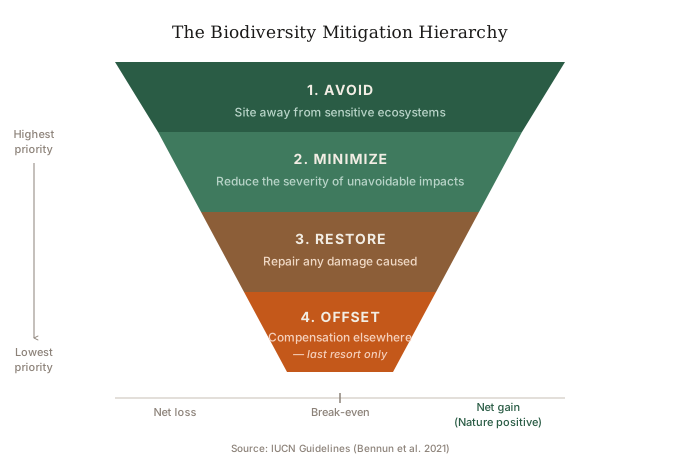
Consider what this means in practice. Rather than viewing biodiversity protection and renewable energy as competing priorities, nature-positive energy seeks configurations where both goals advance simultaneously. A solar farm on degraded brownfield land that incorporates native pollinator meadows. An offshore wind project that includes artificial reef structures enhancing marine habitat. An agrivoltaic system that combines food production with energy generation while restoring soil health and supporting farmland biodiversity.
These are not hypothetical scenarios. Germany’s Mooshof solar farm, developed in collaboration with the German Federation for Environment and Nature Conservation (BUND), transformed a degraded corn monoculture into a 4.5-megawatt solar facility with biotope ponds, native flowering meadows, and deliberate gaps in fencing to allow small mammal passage. Post-installation monitoring documented increases in pollinator abundance and bird species richness. In the United Kingdom, research by the Royal Society for the Protection of Birds and Cambridge University demonstrated that solar farms with appropriate vegetation management can support breeding bird populations exceeding those in conventional farmland.
Japan has its own nascent examples. In Gifu Prefecture, a 2-megawatt solar PV project initially faced opposition from residents concerned about a nearby wetland with rare plant species. Through repeated negotiations, the developers agreed to preserve the wetland and reduce the installation area. The wetland was subsequently certified as a Nationally Certified Sustainably Managed Natural Site by Japan’s Ministry of Environment in 2023 and registered as an OECM (Other Effective Area-Based Conservation Measure) in 2024. Local residents formed a group to maintain the wetland, built a boardwalk for nature observation, and now provide environmental education programs for elementary school students.
Why Traditional EIA Is No Longer Enough
Japan’s current environmental impact assessment (EIA) system, governed by the Environmental Impact Assessment Law and various prefectural ordinances, was designed primarily to evaluate and mitigate discrete, project-specific impacts. For most of the system’s history, this was adequate. Development projects were relatively dispersed in time and space. Environmental science had not yet fully grasped cumulative impacts or system-level thresholds.
The renewable energy transition changes this calculus in three fundamental ways.
First, scale and speed. Japan’s 2030 renewable energy targets require deploying solar and wind capacity at a rate orders of magnitude faster than historical norms. This means multiple projects within single ecosystems, cumulative habitat fragmentation, and sequential impacts that compound rather than simply add. Traditional project-by-project EIA cannot capture these cumulative effects. As IRENA’s 2025 report notes, “There is often a lack of awareness among policy makers, developers and the public about the critical intersection between renewable energy deployment and ecosystem health… the cumulative impacts to ecosystems and communities are not yet fully understood and require more data and analysis.”
Second, spatial planning gaps. Effective biodiversity protection requires landscape-level thinking — identifying core habitats, migration corridors, and buffer zones, then directing development away from high-conflict areas toward low-conflict alternatives. Japan has made limited progress on strategic environmental assessments or zoning frameworks that could guide renewable energy siting at this scale. Over 300 local governments have enacted solar regulations, but these are overwhelmingly reactive restrictions aimed at preventing specific harms rather than proactive frameworks for enabling nature-positive development.
Third, the baseline problem. Traditional EIA asks whether a project will worsen existing conditions. But in a world where ecosystems are already severely degraded — the 73 percent population decline documented in the Living Planet Index — “no additional harm” is insufficient. If we merely avoid making things worse, we lock in catastrophic biodiversity loss. The GBF’s commitment to halt and reverse nature loss by 2030 requires going beyond harm minimization to active restoration. This demands a fundamentally different approach to impact assessment — one that asks not “how much damage will this project cause?” but “how can this project contribute to ecosystem recovery?”
The question is not "how much damage will this project cause?" but "how can this project contribute to ecosystem recovery?"
What This Means for Japan
Japan stands at a critical juncture — but not the one often assumed. While global leaders race to triple renewable capacity by 2030, Japan’s 7th Strategic Energy Plan sets a more gradualist course: 40–50% renewable electricity by 2040. This timeline is conservative by international standards. The European Union aims for 42.5% renewables by 2030. The United States targets 100% clean electricity by 2035. Even China, despite its continued coal expansion, is installing solar and wind at a pace that will likely exceed 50% renewable electricity well before 2040.
Japan’s slower approach might seem to reduce biodiversity pressure — more time to plan, less frantic deployment. But this reasoning is backwards. Delayed climate action increases total biodiversity loss through accelerated climate change impacts. And crucially, even Japan’s modest renewable energy targets require substantial land conversion and infrastructure expansion. The question is not whether this expansion will affect ecosystems, but whether it will degrade or restore them.
Moreover, Japan faces a double bind. It is simultaneously failing to meet climate commitments (insufficient renewable deployment) and biodiversity commitments (inadequate integration of ecological considerations into energy planning). The Kunming-Montreal Global Biodiversity Framework requires halting and reversing nature loss by 2030 — a deadline that arrives a full decade before Japan’s renewable energy targets. If renewable energy projects continue to be sited without strategic biodiversity planning, Japan will miss both goals.
These commitments are not contradictory — but neither are they automatically compatible. Making them work in concert requires deliberate policy design, regulatory reform, and stakeholder coordination. The pathway forward has four elements:
1. Adopt Strategic Environmental Assessment. Japan needs national-level strategic siting frameworks that identify renewable energy acceleration areas — zones where environmental impacts are minimal and streamlined permitting is justified — as well as exclusion zones where biodiversity values are too high to permit development. The European Union’s Renewables Acceleration Areas guidance, while imperfect, provides a model. Research has demonstrated that Europe has sufficient low-conflict land to meet its 45 percent renewable energy target by 2030; similar analysis for Japan would clarify where the true conflicts lie and where they do not.
2. Mandate Nature-Positive Outcomes. Regulatory frameworks should move beyond “do no harm” to require measurable biodiversity improvement. The United Kingdom’s Biodiversity Net Gain policy, implemented in February 2024, mandates that development projects achieve a 10 percent biodiversity increase maintained for at least 30 years, calculated using standardized metrics. Germany’s 2024 Solar Package 1 requires ground-mounted solar installations to meet minimum biodiversity criteria — native vegetation, wildlife passage, biotope creation — to qualify for support mechanisms. Japan could adapt these models to its ecological and institutional context.
3. Strengthen Cumulative Impact Assessment. The current EIA system must evolve to capture cumulative effects across multiple projects and account for synergistic impacts. IUCN’s 2024 guidance on cumulative impact assessment for wind and solar developments provides practical methodologies. This requires better data infrastructure — biodiversity baselines, species distribution models, ecosystem vulnerability assessments — and interagency coordination between the Ministry of Economy, Trade and Industry (METI) and the Ministry of Environment (MOE).
4. Enable Community Participation. The Gifu wetland case succeeded because developers engaged meaningfully with local concerns. Such engagement should not be exceptional; it should be standard practice. IRENA’s “Engage local actors” principle reflects growing recognition that community involvement improves both project design and social acceptance. For Japan, with its tradition of municipal autonomy and rich local ecological knowledge held by aging rural populations, participatory processes are both culturally appropriate and technically valuable.
The alternative to reform is continued conflict. Already, opposition to renewable energy projects based on environmental concerns has delayed or blocked developments across Japan. The December 2025 Cabinet-level “Countermeasures Package for Large-Scale Solar Power Generation Projects” (Mega-Solar Taisaku Package) responded primarily to public backlash, but it remains grounded in the conventional framework of tightening restrictions rather than enabling nature-positive approaches. Without a paradigm shift toward integrated climate-biodiversity planning, Japan risks a lose-lose outcome: insufficient renewable energy deployment and continued biodiversity decline.
A Path Beyond Trade-Offs
The triple crisis demands triple solutions. Climate change, biodiversity loss, and pollution cannot be addressed independently — but neither are they insurmountable when tackled together. Nature-positive renewable energy represents one pathway to integrated action: expanding clean energy capacity while simultaneously restoring ecosystems, enhancing carbon sequestration, and supporting rural livelihoods.
This is not wishful thinking. The scientific literature, policy frameworks, and on-the-ground examples demonstrate feasibility. Germany’s Solar Package 1, though limited, proves that biodiversity requirements can be institutionalized in renewable energy policy. The UK’s Biodiversity Net Gain system, despite implementation challenges, shows that measurable nature improvements can be mandated at scale. Japan’s own Gifu wetland case reveals that collaborative solutions are possible when stakeholders engage in good faith.
What is required now is recognition of Japan’s double jeopardy. The country is falling behind on both climate action (40–50% renewables by 2040 while global leaders target earlier dates) and biodiversity protection (inadequate integration of ecological considerations into energy planning). Neither shortfall can be addressed independently. Japan’s 2040 renewable energy targets will not be met through business-as-usual project development. The Kunming-Montreal Global Biodiversity Framework’s ambition to halt and reverse nature loss by 2030 — a decade before Japan’s energy targets — will not be achieved through marginal improvements to environmental impact assessments. Both goals demand transformative change in how energy systems are planned, sited, and operated.
The Kushiro controversy was not an aberration. It was a preview of conflicts to come — unless Japan chooses a different path. That path begins with recognizing that the triple crisis has already arrived, that renewable energy and biodiversity protection are not competing imperatives but mutually dependent goals, and that the next four years will determine whether Japan’s energy transition becomes a driver of ecological recovery or ecological loss.
Nature-positive energy is not just possible. In an era of triple crisis, it is necessary.
The choice, ultimately, is whether to continue treating renewable energy and biodiversity as a tragic trade-off — or to embrace the harder but more promising work of making them allies in a shared struggle for a livable planet. Nature-positive energy is not just possible. In an era of triple crisis, it is necessary.
Key References
WWF (2024). Living Planet Report 2024 – A System in Peril. World Wide Fund for Nature.
IRENA Coalition for Action (2025). Nature-positive energy principles: Environmental siting and permitting of solar, wind and grid infrastructure. International Renewable Energy Agency.
Pörtner, H.O., Scholes, R.J., et al. (2021). IPBES-IPCC co-sponsored workshop report on biodiversity and climate change. IPBES and IPCC.
CBD (2024). Kunming-Montreal Global Biodiversity Framework. Convention on Biological Diversity.
Bennun, L., van Bochove, J., et al. (2021). Mitigating biodiversity impacts associated with solar and wind energy development: Guidelines for project developers. IUCN.
Yamashita, N., & Doedt, C. (2026). 「自然共生型再エネの実践と制度化の展望」『環境経済・政策研究』第19巻第1号、53–58頁。
SolarPower Europe & The Nature Conservancy (2024). Rewarding and incentivising nature-inclusive solar through EU policy.
Copping, J.P., et al. (2025). “Solar farm management influences breeding bird responses in an arable-dominated landscape,” Bird Study, 72(3), 217–222.
UNFCCC (2022). What is the triple planetary crisis? United Nations Framework Convention on Climate Change.
European Commission (2021). EU biodiversity strategy for 2030: Bringing nature back into our lives.